
The eMoto Show – Episode 1
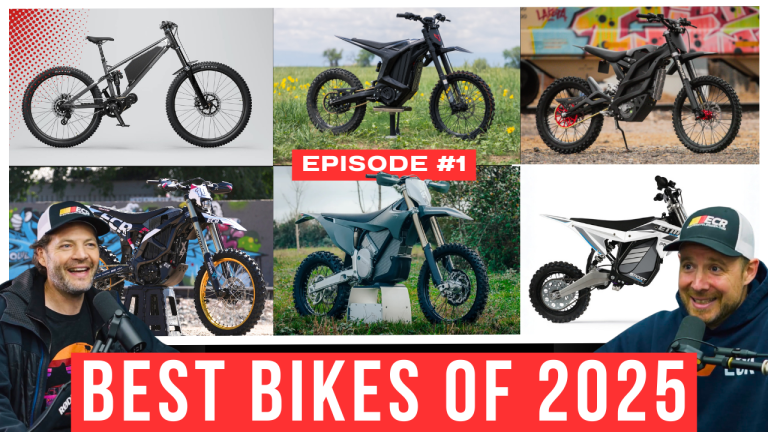
The eMoto Show – Episode 1 – Best Bikes of 2025 [Text Transcript]
Every year, we get to test a ton of bikes here at ECR, and a few always stand out for different reasons. It’s always fun to look back at the previous year and see which bikes really made the biggest impact on us.
That’s what we’re doing today — running down the list of the bikes that mattered most to us in 2025.
We’ve also got Bryan here. Bryan’s been on pretty much every single bike that came through the shop in 2025, and he definitely has opinions. 2025 was a huge year for the electric motorsports industry — especially electric dirt bikes — so let’s get into it.
Most Unexpected: Bonnell 775 MX
Tucker: Alright, first up. I don’t know if this was your “favorite” bike, but it seemed like the one that made the biggest impact on you: the Bonnell 775 MX.
Bryan: I’ve dreamed of a bike like this since the Stealth Bomber days.
Tucker: The Stealth Bomber.
Bryan: Yep. They tried, but didn’t quite hit the mark — and that was 15 years ago. Bonnell wasn’t the first to try this style of bike, but they were the first to come out with one that felt dialed in: good geometry, and a price that made sense. It felt like they nailed it right out of the gate.
Tucker: And they did a great job getting it into the right hands. That bike made a huge wave. For us, it felt like one of the biggest bikes of 2025.
Bryan: And for good reason. It comes in actual sizes — medium, large, and extra large — which is so nice for different height riders.
Tucker: Totally. It’s comfortable for different riders, and it feels familiar if you come from mountain biking. You already understand sizing and geometry, and honestly they nailed that modern feel.
Bryan: A lot of lightweight e-motos keep adding power, and they’re fun, but in our terrain they can feel like they toss you around if you ride them hard. The Bonnell is interesting because it’s lighter than a lot of those bikes, but it rides more like a downhill mountain bike.
Tucker: Exactly. You can ride it like a downhill bike — and when you do, it soaks up the trail better than any of the lightweight e-moto bikes we’ve tested. It feels like a purpose-built performance lightweight platform.
Bryan: It’s also an absolute fun machine at around 80 pounds. You can throw it on a bike rack — a sturdy one — but you don’t need to load it like a full motorcycle every time. That alone means I ride it more often.
Tucker: It has pedals too, which is both cool and also a little vulnerable, because this bike can move. It tops out around 38 mph.
Bryan: And with the pedals, it can get less attention than a Surron-style lightweight bike in certain areas. It still looks aggressive — big battery in the frame — but it reads more like a bike than a motorcycle at first glance.
Tucker: You can also choose a low-power mode and keep the speed limited. Let’s be clear: it’s not a Class 2 bike — it’s a legit electric dirt bike — but you can limit it. And we’ve only ridden it on moto trails or moto-legal hybrid trails. We’re not taking this onto mountain-bike-only trails.
Bryan: But it definitely feels like it fits multi-use settings a little better than showing up on a Surron.
Tucker: It created a new category that’s been right on the edge for a while — and it helped establish what a lot of people now want to ride.
Battery Range and Durability Notes
Tucker: Battery range — is that a pro or a con?
Bryan: Range varies a lot depending on mode, climbing, and whether you’re pedaling. It can be less than some other bikes, but it’s also lighter — and I don’t necessarily want it to get heavier.
Tucker: One thing we learned is: you can ride it harder than some of the parts were originally happy with. The rear wheel didn’t love getting smashed through rough terrain at high speed.
Bryan: But that’s something they addressed with the Version 2 updates: thicker-gauge spokes, a welded rim, and a Tannus insert. And they were developing a stronger rear hub too — because that’s a lot of power to put through a bicycle-style rear hub.
Tucker: It’s also single-speed — no gears. You can swap rear sprockets depending on whether you want more torque or more top speed.
Bryan: What’s exciting is how this segment will evolve: more robust rear hubs, wheels, and tire interfaces — while still keeping the weight in check.
Tucker: One of the coolest things is the downhill feel — and then you can goose the throttle just a little to pop off something or accelerate out of a feature. That’s a unique experience.
Bryan: It reminded me of the first time I rode an e-mountain bike. Familiar in some ways, but also totally new. I felt that the first time I rode a Light Bee, and I felt it again on the Bonnell.
Best Out of the Box: Stark Varg (EX / MX 1.2)
Tucker: Next up — and in my opinion the best bike out of the box — the benchmark: the Stark Varg.
Bryan: The first time you ride it, you can tell how much R&D went into it. It feels like they listened to riders — including high-end riders — but it’s also still fun and manageable for non-pros because you can turn the power way down.
Tucker: The geometry is great. It’s stable and predictable. Real dirt bike components everywhere. It feels like the most “ready to ride” bike right off the showroom floor.
Bryan: It’s expensive, but it feels like you can do nothing to it and still have an amazing motorcycle. And it’s kind of the ultimate vet bike — it makes average riders feel fast and confident.
Tucker: The linear power delivery is what really blew me away. If you want more, you twist more — but it doesn’t do anything surprising. Especially if you keep it at a reasonable power setting.
Bryan: And for 2025, we should mention the MX 1.2 updates. The Varg didn’t originally launch in 2025, but they refined it.
Tucker: Everything feels premium. And I’ve grown to appreciate how good KYB suspension is. The SSS setup on this bike is excellent.
Bryan: We had it tuned with our partner Tyler at Applied Technologies. It was already good, but once it was dialed for your riding, it went to another level.
Tucker: Tyler calls it the “Corks” setting — like Colorado off-road series — a mix of motocross and off-road. Not full moto, not full off-road, somewhere in between. It felt supple, but it didn’t blow through the travel on big hits. The suspension is unreal.
Bryan: The chassis complements it too. It’s point-and-shoot. It turns easily. And throttle feel is a huge one: on a lot of bikes lately, the wrist-to-rear-wheel feel is vague. On the Varg, it feels connected — like your wrist and the rear wheel are one.
Tucker: It’s also one of the heavier electric dirt bikes on paper, but it doesn’t feel that heavy when you’re riding — only when you’re lifting it onto a stand.
Bryan: Exactly. On the scale it’s heavy, but on track it feels nimble and agile. They did an amazing job with weight distribution.
Tucker: Battery placement is also a big part of that — low and forward. But the trade-off is it’s not a quick-swappable battery. They clearly prioritized performance and handling over easy swapping.
Tucker: I do want to call out a downside. The smartphone.
Bryan: 100%. It’s driven us crazy.
Tucker: I wish it had a simple dummy display — even something small — so you could tune on the phone but not depend on it to ride. I want to set it and forget it.
Bryan: Especially because we’re often not in cell range. You’re logged out, you need a password, something needs an update, connectivity issues — and you just want to ride your dirt bike.
Tucker: Exactly. Give us battery percentage and power mode — that’s all we need.
Bryan: Still, best out of the box goes to the Stark Varg.
Most Versatile: 2025 Surron Ultra Bee
Tucker: Next up — probably my favorite bike of the year and maybe the last couple years. Most upgradable, most versatile: the Surron Ultra Bee.
Bryan: That bike defined a whole new segment. And the aftermarket is a huge part of why it’s so cool.
Tucker: The Light Bee used to own the “aftermarket king” title. The Ultra Bee has caught up fast. You can build it into a hard enduro bike, or build it into a motocross bike that can hit big stuff — and everything in between.
Bryan: Build quality is excellent for the price. The geometry is solid. It has a full-size seat, good plastics, bigger chain, a large battery, and a good motor.
Tucker: And in 2025, we did see upgrades compared to the original Ultra Bee: slightly larger battery capacity, stronger motor, and more refined front suspension.
Bryan: The big one was more power. The original had enough, but it always felt like it needed just a little more. Not a power war — just the sweet spot. That 18 kW range is the sweet spot, and that’s where it landed.
Tucker: You can do a lot with that power. And not everyone needs to modify it — if it works for what you want, great. But the upgrade potential is endless.
Wheel Setup and Suspension Upgrades
Bryan: It was also cool seeing the 18-inch rear option. The 19/19 setup is weird for off-road. And depending on budget, a 21-inch front is one of the best changes you can make.
Tucker: I’m still surprised they never fully embraced a 21-inch front option from the factory. For the riding we do, it feels like a mandatory upgrade. It improves rollover and corrects the geometry.
Tucker: And we have to shout out Sirris. They nailed the Ultra Bee with the F43 fork and R46 shock. It transformed our bike. Good suspension changes everything.
Brian: Once you had Sirris suspension, 21/18, EBMX X9000, and a few other things — that Ultra Bee became your go-to for a lot of rides.
Tucker: And yeah, it’s one of those bikes that people sometimes underappreciate because they compare a heavily modified Ultra Bee to a Varg. But in certain environments, I’ll pick the Ultra Bee — and I know I’ll be faster on it.
Ultra Bee Wish List: What We Would Like To See Updated
Tucker: Two big wish-list items.
Bryan: First, a 21-inch front option from the factory.
Tucker: Second, I’d love to see a gearbox or gear reduction instead of the belt. Even if it added weight, I’d still want it — especially since belt failure far from the truck is a brutal push.
Bryan: The stock belt is strong, but once you start adding power — bigger battery, controller, motor — you’re asking more and more from it.
Tucker: And the other big issue we ran into in 2025: the swingarm.
Bryan: Yep. The lack of a boxed swingarm. We’ve seen it across a lot of Chinese-made bikes. When you land hard or land on throttle, the swingarm can crack or flex. Once it flexes, you start throwing chains, bending sprockets, and chasing problems until you realize what’s actually happening.
Tucker: We found a hairline crack. Under load, it flexed, we threw chains, and it took time to pinpoint. I’d rather have a little more weight and a stronger swingarm that can handle hard riding.
Battery Swapping and Real-World Racing
Bryan: The Ultra Bee is also one of the only bikes in its size category where you can race with full-size bikes and swap batteries.
Tucker: Exactly. At the San Isabel Enduro, I brought multiple batteries and swapped throughout the race. That wouldn’t have been possible on the Varg. It was around 65 miles in the Colorado mountains, and battery swapping is what made it doable.
Bryan: The 2025 battery was larger — did you see more range?
Tucker: A little, but not huge. The bike also had more power, and you tend to use more energy when it feels faster. If you want real range gains, you go aftermarket.
Bryan: And weight-wise, the stock bike is around 190 pounds. Built bikes can land in the low-to-mid 200s.
Tucker: And honestly, the market sometimes over-focuses on weight. Adding weight to the Ultra Bee didn’t ruin it — in many ways it made it feel more planted and stable.
Bryan: Ultra Bee isn’t new, but 2025 brought meaningful updates. Still one of our favorites. Most adaptable, most upgradeable — and we think 2026 is going to be big for that midsize category.
Best Pit Bike: Electro & Co ETM RTR
Tucker: 2026 is going to be huge for midsize, but 2025 was also the precursor for another category that’s about to explode: the real pit bike category.
Bryan: And the standout in 2025 was the Electro & Co ETM RTR.
Tucker: Electro & Co has been around the pit bike and Razor world for a long time, so this is their wheelhouse. It was cool to see them go all-in — but build something adult-ridable and high quality.
Bryan: A lot of bikes in this category can feel like the manufacturer is just tossing something out there to see what sticks. But Electro & Co lives this stuff. They’re riders, they test, and they know what makes a bike good.
Tucker: The RTR came out powerful, with solid suspension, dialed geometry, good tires, great plastics, and a lot of tunability. And it’s affordable for what you get.
Bryan: They also offer a bunch of parts and tried to make it maintenance-friendly.
Tucker: It still carries some Razor DNA — like the motor on the swingarm — which is different than most dirt bikes. But for what it’s for — backyard tracks, jumps, messing around with friends — it works.
Bryan: It also held up to abuse. Big riders were coming up short, overshooting, smashing the bike, and it kept taking it.
Tucker: It wasn’t the only bike in that category, but it shined the brightest in 2025.
Best Hyperlight: Ventus One Plus
Tucker: Next category: what we coined in 2025 as “hyperlight.”
For years, the lightweight category was basically Surron Light Bee size bikes — not crazy power, not crazy speed. But one by one, bikes in that chassis size kept getting more powerful. At this point, you can’t compare a classic Light Bee to the highest output bikes in this segment anymore.
So we started calling it the hyperlight category: still small and lightweight, but with insane power.
Best hyperlight all-around bike: Ventus One Plus.
Bryan: The Light Bee was like 6 kW. Now these bikes are way beyond that. But with more power comes more responsibility in how it’s delivered — and the Ventus really impressed me with throttle-to-rear-wheel feel.
Tucker: It’s fast, but the connection is good enough that you can almost be your own traction control on technical climbs.
Bryan: And it’s extremely customizable. You can tune the power a lot in the app, and really shape the bike into what you want.
Fixes and Downsides We Noticed
Tucker: Out of the box, we had to address bars and ride height — front end correction.
Bryan: A lot of these bikes ship with 70/100-19 front tires that have super short sidewalls, and the bike ends up raked out — low front, high rear. Fine on pavement, but off-road it’s not great.
Tucker: We fixed it with a taller front tire (Dunlop MX34), a drop clamp to bring the front end up, and taller bars. That changed the whole attitude of the bike and made it way more off-road friendly.
Bryan: The RFloXa fork setup it comes with is good — it just needed that extra adjustment.
Tucker: One downside we’ve consistently seen with this chassis (the 79 platform) is linkage play over time — especially when ridden hard. Bearings wear, hardware grooves, and the play increases. We didn’t have a perfect fix for that.
Bryan: Another issue we see on high-power jackshaft/belt bikes: if you land on throttle, you can shred belt teeth. It might not snap, but it can destroy the belt.
Tucker: That happened to me racing the Ventus One Plus in a Rocky Mountain Enduro Circuit event. Landed on power off a small tabletop, heard the belt rip teeth off, and had to switch bikes for the rest of the day.
Hyperlight Runner-Ups
Tucker: We tested a ton of hyperlight bikes this year. Any runner-ups?
Bryan: The top three all had strengths. The Ventus had tunability. The 3.0 felt really dialed and confidence-inspiring, even if it’s less powerful. And the Arctic Leopard had amazing range and a gearbox — plus a longer swingarm — but the suspension felt stiff on longer off-road rides.
Tucker: The 3.0 was surprisingly loved by almost everyone. It didn’t overwhelm the chassis the way the SR sometimes can.
Bryan: The SR can feel like a two-stroke powerband in the dirt — it ramps up aggressively and can get wild fast.
Tucker: We should also mention the SR Special Edition (19/16) that came out in 2025. We didn’t have it for the shootout, but it felt like it leveled up the SR: better front height out of the box, more tunable feel, and the 16-inch rear opens up a ton of tire options.
Best Battery Range: Arctic Leopard
Tucker: Battery range is always one of the biggest topics with electric dirt bikes, and it seems like every time we do a range test, Arctic Leopard is either the winner or right there at the top.
Bryan: It’s not like they’re underpowered either. Some of those bikes are honestly scary fast.
Tucker: Exactly. Huge range, lots of power. In our hyperlight range test, the bikes died one after another — and the Arctic Leopard just kept going.
Bryan: It went significantly farther. To the point where we were losing daylight.
Tucker: Beers were cracked and you were still out riding trying to kill the battery.
Looking Ahead to Electric Dirt Bikes in 2026
Tucker: Looking ahead, there are a few categories that 2026 is going to be dominated by — especially midsize.
We’re doing a separate video on what bikes are coming in 2026, but the big ones we’re most excited about are:
- Dust Moto Hightail
- Bonnell 805
- Bonnell 902
Bryan: Those bikes were the talk of the town. We saw them at the industry show, they looked solid, and it’ll be exciting to see how they get fine-tuned between prototype and production.
Tucker: We’ve swung a leg over all three. They exist — they’re not just renderings on a screen. That midsize category is my favorite, and I think 2026 is going to be a massive year for e-motos.
Bryan: The biggest takeaway from 2025 is that bikes are improving fast. Manufacturers are listening and making changes riders actually want.
Tucker: Those were our favorite bikes of 2025. If we missed any you think should have been on the list, let us know. And stay tuned for the “Bikes Coming in 2026” episode.