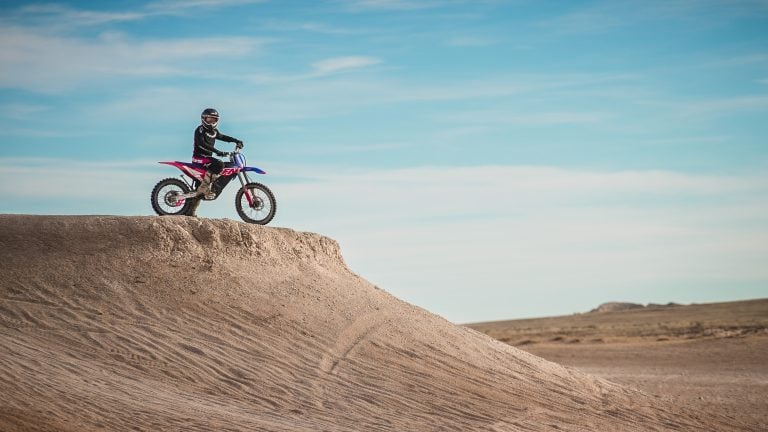

Every once in a while, a bike shows up without an overhyped marketing campaign from a brand you may not have fully had on your radar – and it forces you to take a second look. That’s been our experience with RFN over the past few years. We’ve spent time on some of their earlier, smaller platforms, including the Rally Pro and what many riders knew as the Beta Explorer, and it was clear even then that RFN was laying groundwork. Since those bikes, they’ve been quietly refining their approach, and the Warrior Pro lineup is where that effort really comes into focus. This is the first time RFN feels like it’s stepping directly into the mid-size electric dirt bike conversation in a serious, intentional way.
RFN (via Apollino) has been pretty open about what they’re trying to do with the Warrior platform: build a true progression of off-road electric dirt bikes, from kids bikes all the way up to legitimate Pro-level machines. Rather than forcing one chassis to cover every rider and riding style, the Warrior family is broken into clear displacement-equivalent classes, much like the gas world. The E5 fills the 50cc role, the E8 slots into the 65cc category, and the E15 lineup targets the 85cc class. Within that top tier, RFN splits the difference further with the E15 and E15 Plus—the standard E15 running a 16/19 wheel setup for smaller or younger riders, and the E15 Plus stepping up to full 18/21 wheels for taller riders and more aggressive off-road use. Each model is engineered to match the size, power, and riding expectations of its class, and that intentional, purpose-built approach carries through everywhere on the bike.
The bike we’ve been riding is the Warrior Pro E15 Plus, and in person it immediately reads as a real dirt bike. The seat height is tall enough that you notice it before you even throw a leg over, and once you’re on it, the proportions feel closer to a small-bore motocross bike than a typical mid-size e-moto. It’s tall (only half an inch shorter than a Husqvarna TC125) and built in a way that immediately reads more like a dirt bike than a toy, pit bike, or another bicycle hybrid with a motor.
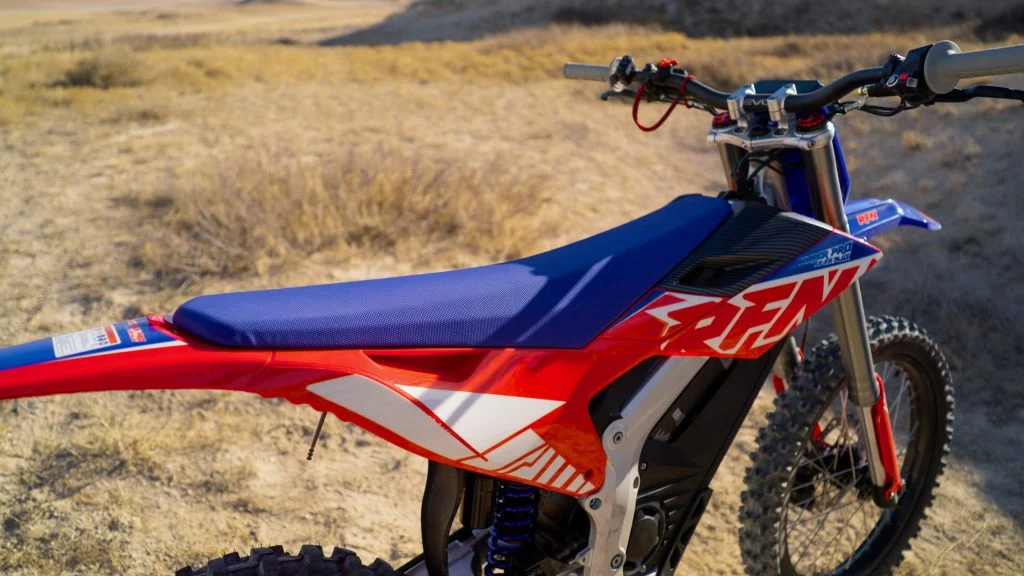
RFN lists a 920mm seat height, and that number checks out in how it feels under you. It’s also rolling on a proper 21/18 wheel combo, which changes the entire vibe of the bike the second you drop into ruts or start slicing through rocks. And RFN didn’t cheap out on the tires, either. The Kenda setup they spec’d is one of those little details that tells you the product team actually rides, because traction is paramount on an electric dirt bike, and this thing hooks up.
We started our ride in the mountains, in that rare window of late-season “this shouldn’t be good right now, but it is” hero dirt. The Warrior Pro felt immediately nimble and agile. Direction changes felt effortless. The front end felt planted and confidence-inspiring without feeling lazy. You can initiate your turn and the bike just wants to hold its line, which is one of our favorite characteristics on any dirt bike because it lets you ride harder without your brain doing math around whether the front end is going to oversteer or understeer.
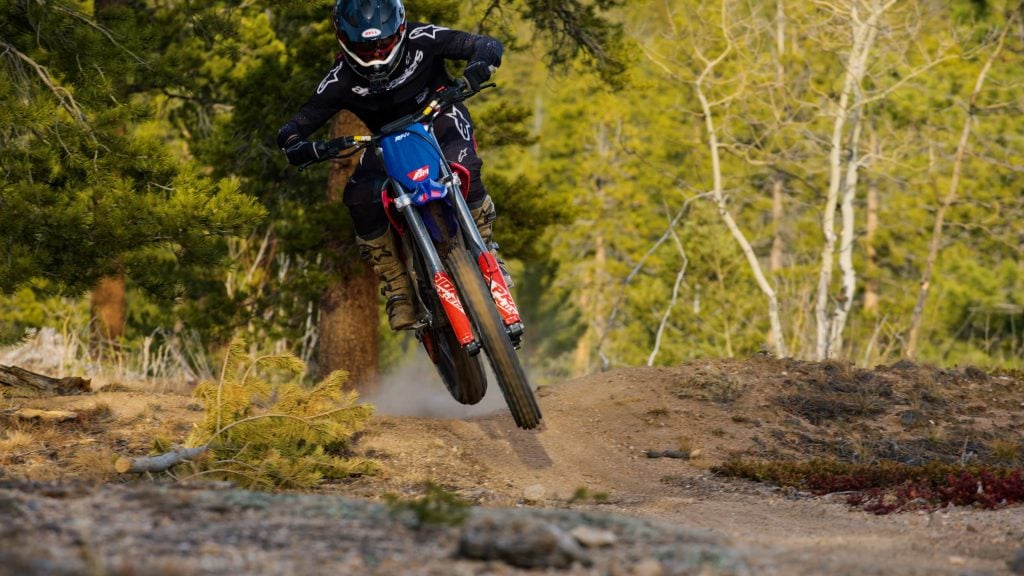
A lot of that “pointed” front end is the normal-ish full-size geometry you get from a 21-inch front wheel and a fork that feels more moto than lightweight eMoto. The fork on this bike was a highlight in the rocks. It’s plush, it’s soft in a way that works off-road, and it doesn’t ping-pong or deflect off every little sharp edge the way some bikes in this category do when they’re overdamped or under-supported. The front tracked straight and true, and it gave us that calm, stable feeling you want when you’re threading through chunk.
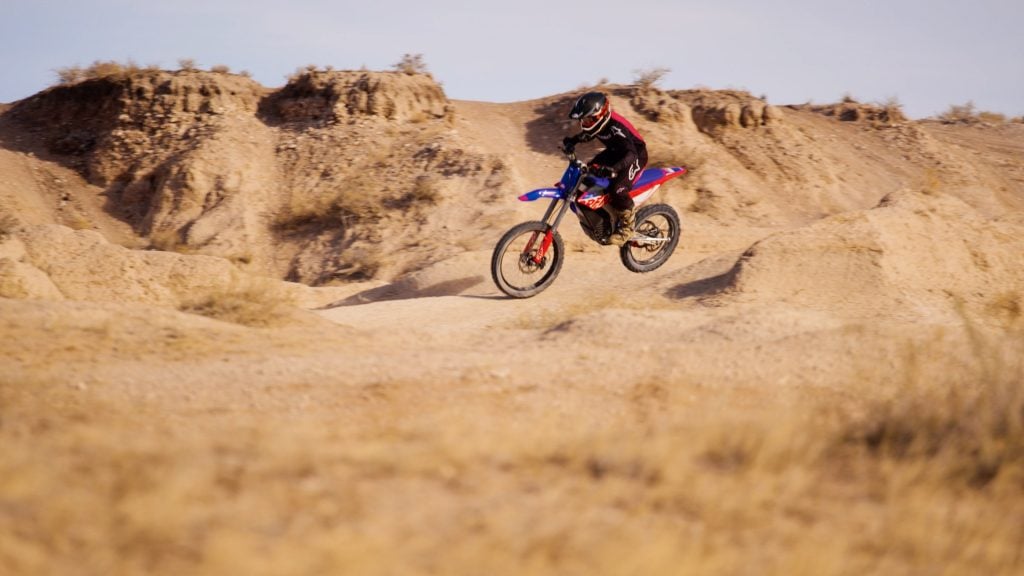
The rear of the bike is where the Warrior Pro develops a personality. It feels short back there, and it rides like it. You notice the swingarm is short visually, and you really notice it when you start pushing the bike through turns. The rear end turns crazy quick. In tight singletrack, it makes the bike feel nimble for how tall it is. It’s poppy, lively, and fun. There is a tradeoff though, and that is stability. The rear felt a little soft for our pace and it had a tendency to kick a bit, especially once speeds pick up or the trail gets choppy in a way that loads and unloads the shock quickly. That could be spring rate, clickers, or just the nature of a shorter rear end and linkage design. None of it felt like a deal breaker, but it’s something we’d want to tune if this were our long-term bike.
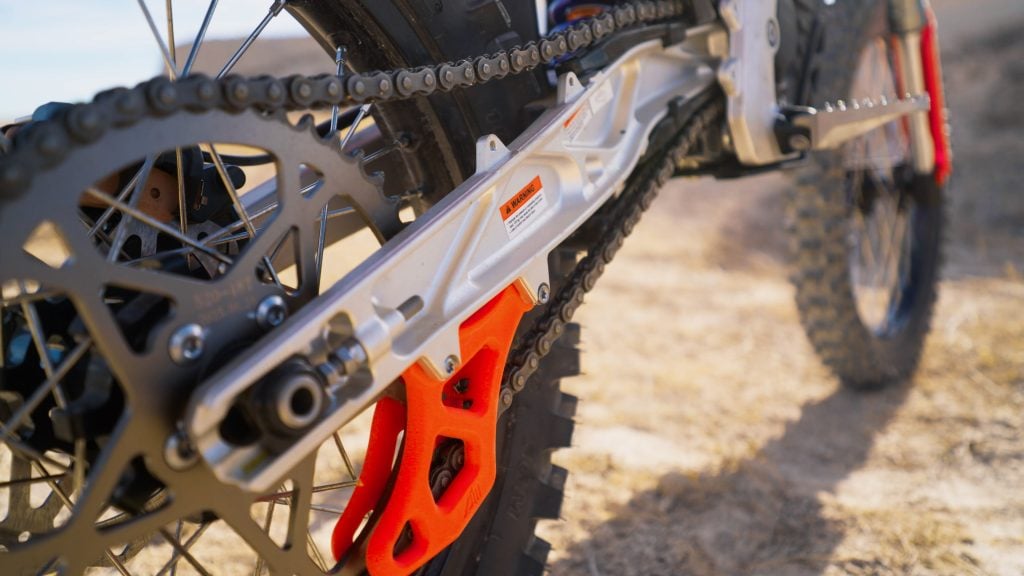
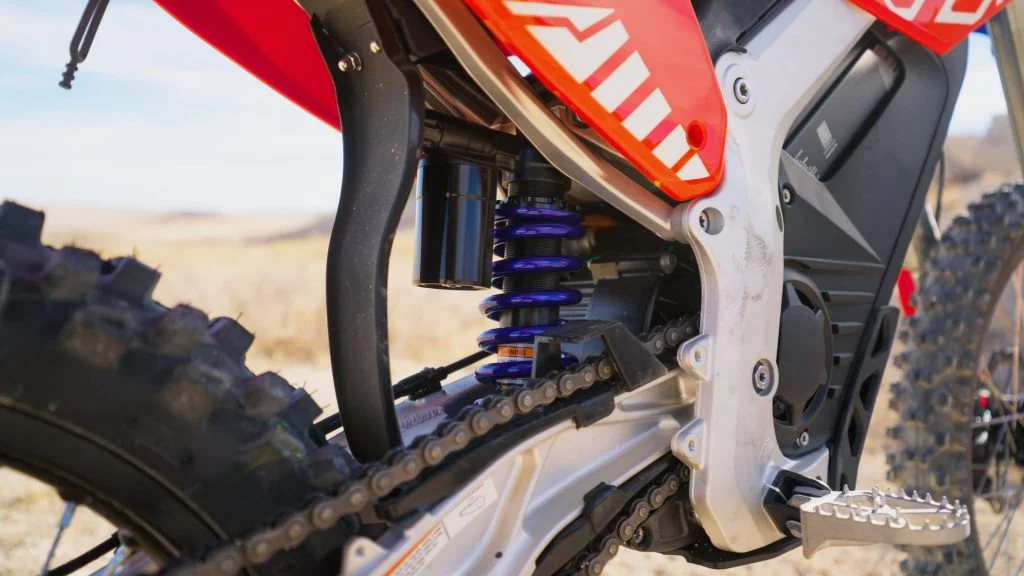
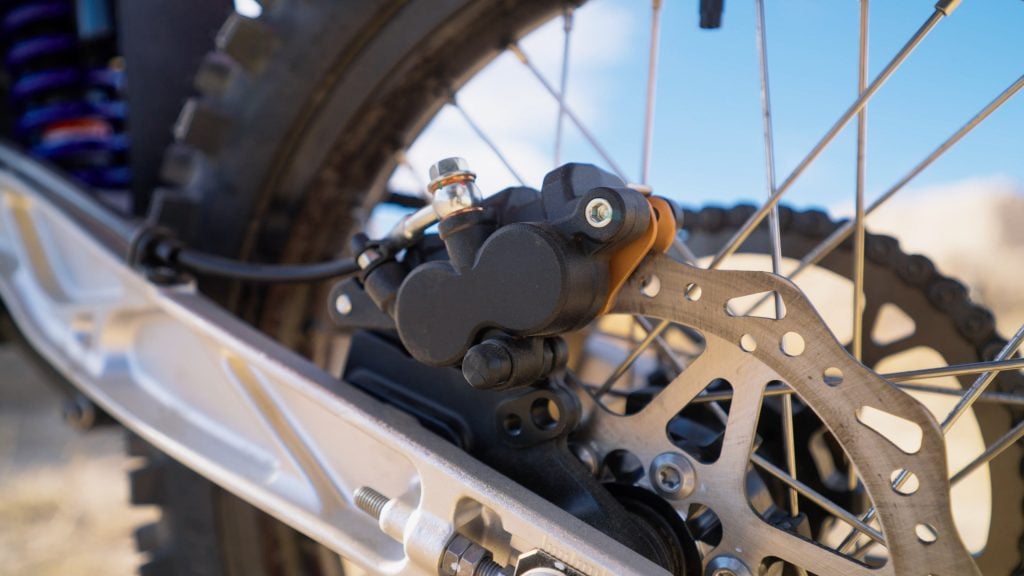
Braking is another area where the Warrior Pro surprised us. A lot of electric dirt bikes show up with brakes that look the part but don’t feel the part. The Warrior Pro’s brakes actually feel sharp and strong, and on a bike that isn’t featherweight, that matters. Grab a handful and the bike responds the way you expect a dirt bike to respond. That sounds basic, but it’s not a given in this segment yet.
Now, zooming out from our ride day and looking at where RFN is aiming this whole Warrior Pro push, it’s also worth mentioning that these bikes have already been showing up in real events. RFN made a point of taking the Warrior Pro into the Red Bull Tennessee Knockout, lining up in the eMoto classes, and they’ve even framed it as part of their global “pro debut” and racing push around that event. We actually saw the bike at TKO ourselves before we got proper seat time, and seeing a platform show up in that environment is a different kind of signal than a glossy promo video. It doesn’t mean the bike is perfect, but it does mean the brand is treating it like something that should be raced, not just sold.
And that really tracks with RFN’s bigger picture right now. The Warrior Pro may be the “big kid” in their lineup, but it doesn’t exist in isolation. It sits at the top of a clearly defined Warrior progression that starts with the smaller E5 and E8 models and works its way up through the E15 and E15 Plus. Instead of asking one bike to serve every rider, RFN has built a ladder that mirrors the traditional 50cc, 65cc, and 85cc pathways, allowing riders to grow within the same platform as their skills, size, and expectations evolve. Taken as a whole, the Warrior lineup feels intentionally structured around real use cases—youth development, intermediate progression, and finally race- and training-oriented riding—rather than a single compromised design trying to cover too much ground.
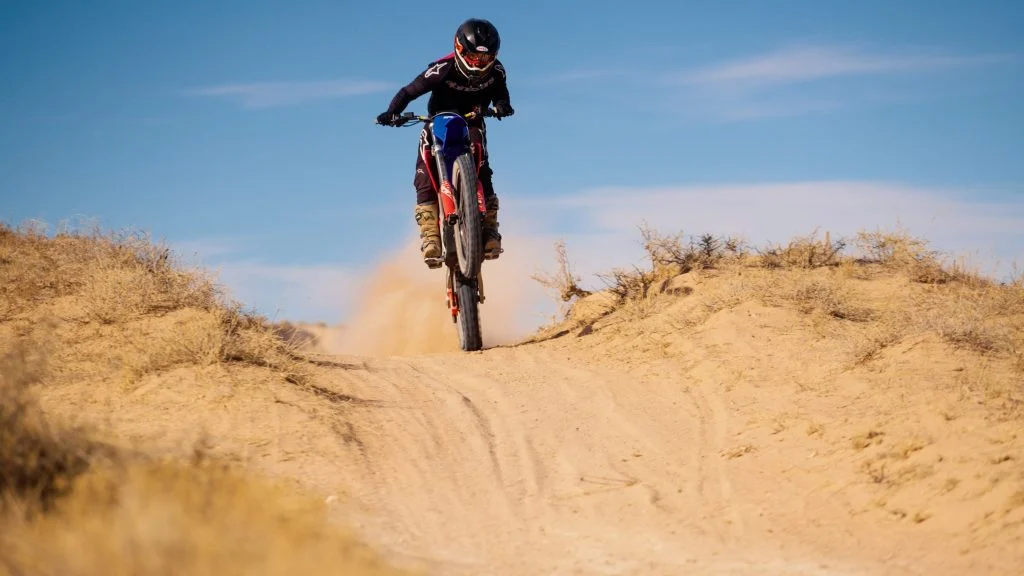
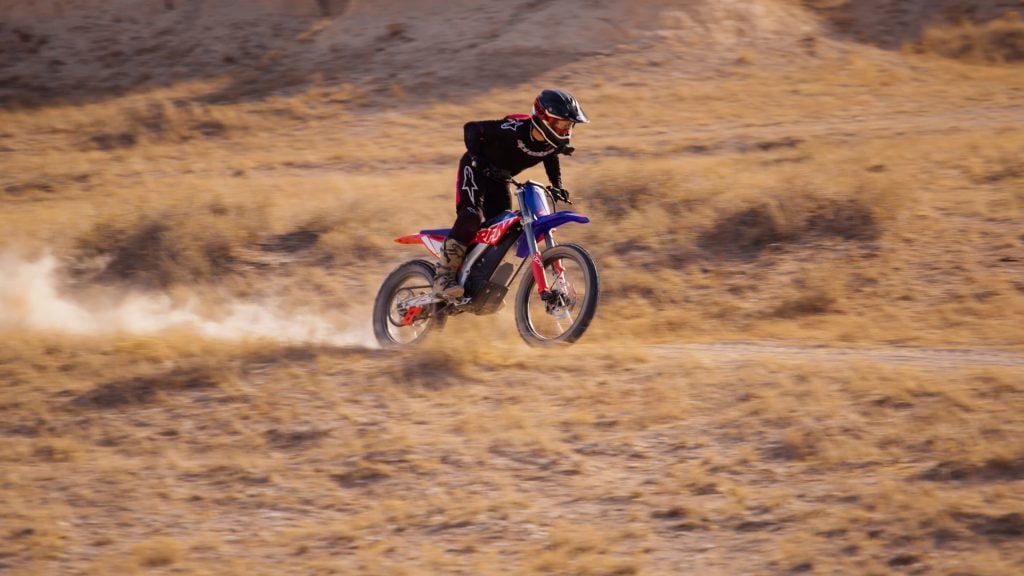
Back to our specific Warrior Pro 15 Plus test, power delivery is where the story gets a little more complicated, because it depends heavily on where you ride. In tight singletrack, it felt most at home. It’s got good low-end snap and it’s spunky out of corners, which is the exact zone you live in when you’re weaving through trees and trying to keep momentum. The throttle connection right off the crack felt good, too. Where we started wanting more was as speeds climbed and the terrain opened up. Mid to top, the bike signs off earlier than we’d like, and out in the desert that became even more obvious. If you’re riding “upper second gear, third gear” kind of off-road speeds for long stretches, this gearing and tune start to feel like the bike is asking you to stop revving it and go back to tight sections.
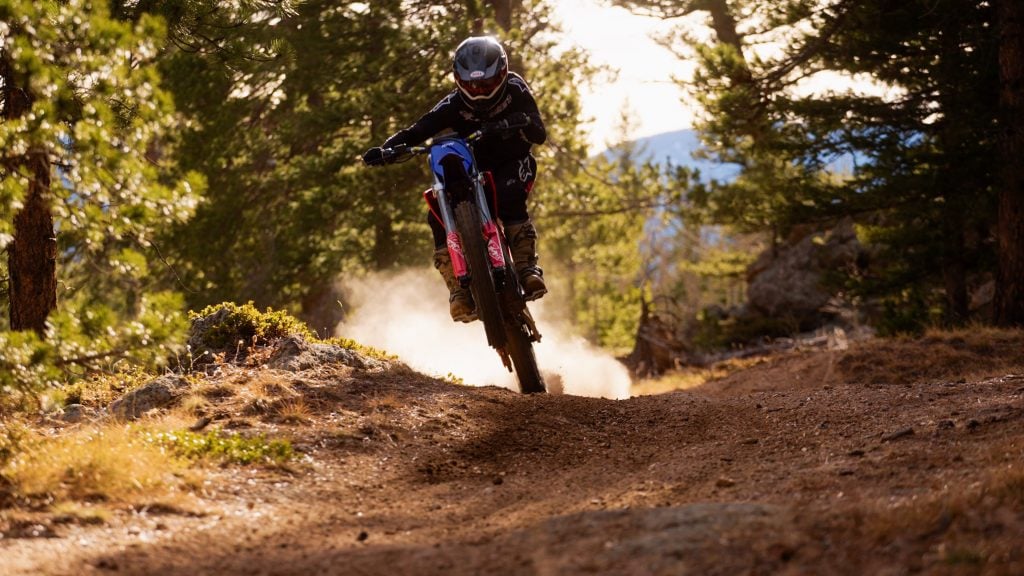
The easiest way to frame the Warrior Pro 15 Plus is to think of it as sitting very close to a traditional 85cc gas bike, but with a different delivery philosophy. Coming out of corners or popping up short climbs, the bike feels lively and eager, and it gets into its power without needing to be revved or “set up” the way an 85 does. In tight singletrack or lower-speed technical riding, that instant acceleration actually makes the Warrior Pro feel competitive, and sometimes even easier to ride, because the power is always right there when you ask for it. Where the comparison shifts is in the mid to top end. A well-ridden 85cc gas bike will pull harder once it’s up in the meat of the powerband, and it will continue to build speed in a way the Warrior Pro doesn’t quite match. The tradeoff is effort: you have to work an 85 harder, keep it on the pipe, and be more deliberate with clutch and throttle to get that performance. The Warrior Pro gives you usable drive with less rider input, but it doesn’t have that same sustained pull once speeds climb.
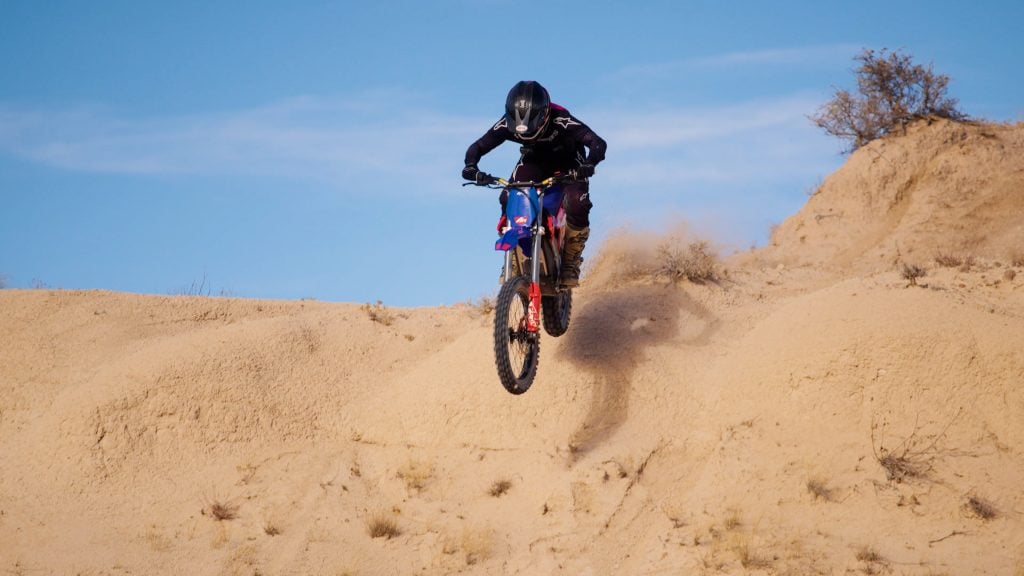
We also noticed that the throttle felt a little vague in that mid-range zone when making really fine blip inputs. It’s not that it’s uncontrollable. It’s more like you feel slightly disconnected between the wrist and rear wheel in the middle of the power curve, whereas the bottom end feels more direct. That could be a tuning thing, and it’s the kind of thing we’d love to revisit if the aftermarket ever gets deeper into this platform.
Which brings us to the real elephant in the room: battery range.
We did two range runs from 100% down to 5%, one in the tighter mountain singletrack we ride most often and one in faster, more open terrain. We saw 15.1 miles in the singletrack and 13.3 miles in the open. Those aren’t unusable numbers, but they’re not great either, and they’re going to be the deciding factor for a lot of trail riders. RFN’s own spec sheet lists 80km (49.7 mile) range, but like always, published range and real riding are two different realities. RFN has also been clear that this bike is aimed more at an 85cc-style track/race environment where riders are often featherweight, long range matters less and riders are swapping batteries between motos, and with that context, our results are slightly more digestible. But if your idea of a good day is a longer trail loop without thinking about the battery, this is the one limitation you need to go into with eyes open.
We also had two small “our bike” notes that are worth mentioning because they’re the kind of real-world stuff that shows up on customer bikes. We noticed the front brake line doing things it shouldn’t, diving toward the wheel under compression. On ours, the reinforced section was secured in the wrong position when it arrived, and we didn’t catch it until after we’d already been riding. We’ve seen other Warrior Pros where the line sits correctly, and this should be a straightforward routing fix, but it’s still something you should check before you ride. We didn’t. And yes, it uses a rubber kickstand retainer; if you forget to hook it, you’ll have a couple “why is my kickstand doing that” moments on camera. We did that too.
So where does that leave us?
The RFN Warrior Pro 15 Plus feels like a proper dirt bike in a way that a lot of mid-size electrics still don’t. The tall stance, the real seat and shrouds, the planted front end, the surprisingly good fork feel in the rocks, the strong brakes, and the way the bike changes direction in tight terrain all add up to a bike that’s genuinely fun to ride in mountain singletrack and woods-style terrain. The short rear end gives it character, and while it costs you some stability, it also gives the bike that quick-turning, playful feel that makes you want to ride it harder.
If RFN can solve the range side of the equation for trail riders, and if they can keep refining the power delivery in that mid-to-top zone, the Warrior Pro platform starts looking like more than just “another new e-moto.” It starts looking like a legitimate contender in the mid-size category, and the fact that RFN is already putting the Warrior Pro name into events like Red Bull Tennessee Knockout tells us they’re not treating this as a side project.
RFN took a big step in the right direction with this bike. We’re excited to see where the Warrior Pro lineup goes next, because the bones are good, the riding experience is real, and this category needs more bikes that feel like dirt bikes first and electric products second.
RFN Warrior Series Spec Sheet
| Specification | SX-E5 | SX-E8 | SX-E15 | SX-E15 Plus |
|---|---|---|---|---|
| Model Code | SX-E5 | SX-E8 | SX-E15 | SX-E15 Plus |
| Age of Use | 6–8 years old | 8–12 years old | 12 years old + | 12 years old + |
| Height | 47–55 in | 55–63 in | 63 in + | 63 in + |
| Battery | 48V 25Ah 8C High rate lithium battery | 60V 35Ah 8C High rate lithium battery | 74V 40Ah 8C High rate lithium battery | 74V 40Ah 8C High rate lithium battery |
| Battery weight | 17.2 lb | 28.7 lb | 37.5 lb | 37.5 lb |
| Motor | 48V 2kW MAX 5kW | 60V 5kW MAX 11.8kW | 74V 8kW MAX 15kW | 74V 8kW MAX 15kW |
| Motor weight | 16.5 lb | 17.3 lb | 25.8 lb | 25.8 lb |
| Range | 18.6 mi (21.7 mph) | 37.3 mi (15.5 mph) | 49.7 mi (15.5 mph) | 49.7 mi (15.5 mph) |
| Charge | DC: 54.6V 4.5A @ 6h | 67.2V 14A @ 3h | 84V 10A @ 4.5h | 84V 10A @ 4.5h |
| Charge weight | 2.2 lb | 7.1 lb | 6.9 lb | 6.9 lb |
| Meter | LED | LCD | LCD | LCD |
| APP | √ | √ | √ | √ |
| Power off switch | √ | √ | √ | √ |
| Peak HP | 6.80 hp | 16.15 hp | 20.39 hp | 20.39 hp |
| Motor torque | 33.2 lb-ft | 33.2 lb-ft | 98.1 lb-ft | 98.1 lb-ft |
| Gear ratio | 13:44 | 9:54 | 11:48 | 11:48 |
| Wheel torque | 106.9 lb-ft | 199.2 lb-ft | 413.1 lb-ft | 413.1 lb-ft |
| Top speed | 37.3 mph | 48.5 mph | 55.9 mph | 62.1 mph |
| Seat height | 26.4–25.4–24.4 in | 29.3 in | 34.6 in | 36.6 in |
| Wheelbase | 41.0 in | 45.1 in | 52.8 in | 52.8 in |
| Steering angle | 42° | 45° | 45° | 45° |
| Ground clearance | 8.5 in | 11.4 in | 11.5 in | 13.1 in |
| Wheel diameter | F 60/100-12 / R 70/100-10 | F 60/100-14 / R 80/100-12 | F 70/100-19 / R 90/100-16 | F 70/100-21 / R 90/100-18 |
| Front suspension | Φ35 – 27.2 in / 7.9 in | Φ35 – 27.6 in / 7.9 in | Φ37 – 33.5 in / 9.4 in | Φ37 – 34.6 in / 9.4 in |
| Rear suspension | 10.8 in / 7.1 in | 12.6 in / 9.8 in | 13.0 in / 11.2 in | 13.0 in / 11.0 in |
| Rear shock spring | 300 lb | 280 lb | 460 lb | 460 lb |
| Handlebar | Φ28.5-22-19 × 26.0 in | Φ28.5-22 × 26.8 in | Φ28.5-22 × 32.1 in | Φ28.5-22 × 32.1 in |
| Brake type | F/R single piston | F/R double piston | F double / R single piston | F double / R single piston |
| Brake disc diameter | F 6.3 in / R 6.3 in | F 8.0 in / R 7.5 in | F 9.4 in / R 8.7 in | F 9.4 in / R 8.7 in |
| Frame material | BIK500 high-strength steel | BIK500 high-strength steel | 6082 forged aluminum alloy | 6082 forged aluminum alloy |
| Rear fork material | 6061 forged aluminum alloy | 6061 forged aluminum alloy | 6082 forged aluminum alloy | 6082 forged aluminum alloy |
| Weight | 103.6 lb | 127.9 lb | 189.6 lb | 198.4 lb |
| Product size | 57.1 × 26.8 × 35.4 in | 64.2 × 28.3 × 38.8 in | 76.4 × 32.3 × 46.5 in | 79.9 × 32.3 × 48.4 in |
| Packing size | 52.0 × 12.8 × 26.0 in | 56.9 × 13.4 × 26.0 in | 66.9 × 15.2 × 33.9 in | 70.1 × 15.2 × 33.9 in |
| Packing quantity | 40HQ: 248 pcs | 40HQ: 204 pcs | 40HQ: 124 pcs | 40HQ: 108 pcs |
| Packing weight | 138.9 lb | 169.8 lb | 251.3 lb | 260.1 lb |
| Max Load | 121.3 lb | 165.3 lb | 264.6 lb | 264.6 lb |